Beyond Entertainment: How Educational Toys Shape Early Brain Architecture
Play is often viewed as a simple break from learning, but for a developing child, play is learning.
In the first few years of life, a child’s brain forms more than one million new neural connections every second. The tools they interact with during this critical window dictate how those pathways form. While standard toys might offer short-term distraction, intentionally designed educational toys act as cognitive tools that stimulate problem-solving, spatial reasoning, and social-emotional growth.
Here is a look at the developmental science behind educational toys and how they support critical childhood milestones.
1. Sparking Spatial Awareness and Engineering Skills
Long before children learn geometry or physics from a textbook, they experiment with these concepts physically through open-ended construction play.
Cognitive Benefits of Toy Interaction:
  ├── 🏗️ Spatial Reasoning (Stacking, Balancing, Aligning)
  ├── 🧩 Logic & Trial-Error (Sorting, Matching, Fitting)
  └── 🎨 Creative Expression (Role-Play, Problem-Solving)
Toys that require stacking, balancing, or interlocking force the brain to calculate gravity, balance, and spatial relationships. When a child manipulates objects to fit together, they are engaged in active spatial hypothesis testing. Research shows that early mastery of these spatial concepts directly correlates with stronger mathematical abilities in later school years.
2. Enhancing Cognitive Flexibility and Logic
True cognitive flexibility is the ability to switch between thinking about two different concepts, or to think about multiple concepts simultaneously.
Pattern Recognition: Sorting toys that classify objects by color, shape, or size train the brain to look for patterns and structures in the environment.
Trial-and-Error Resilience: Puzzle-based toys provide immediate tactile feedback. If a piece does not fit, the child must evaluate why, rotate the object, and try a new strategy. This builds executive function and emotional frustration tolerance.
3. Developing Fine Motor Control and Hand-Eye Coordination
Writing, tying shoes, and using tools all require a high level of dexterity. Educational toys act as a workout for the small muscles in a child’s hands and fingers.
Activities that involve lacing, threading, twisting, or pinching small components strengthen the arches of the hand and improve precision. This physical coordination directly prepares preschoolers for pencil grip readiness and daily self-care tasks.
Choosing the Right Learning Tools
When selecting tools for a home or classroom library, the most effective educational toys share a few distinct characteristics:
Open-Ended Potential: They can be used in multiple ways, allowing the play to grow alongside the child’s expanding imagination.
Sensory Engagement: Tactile variations in weight, texture, and balance provide richer sensory feedback to the brain than flat digital screens.
Appropriate Challenge: They sit perfectly within a child’s developmental window – challenging enough to stimulate problem-solving, but intuitive enough to prevent discouragement.
Products by Category
-
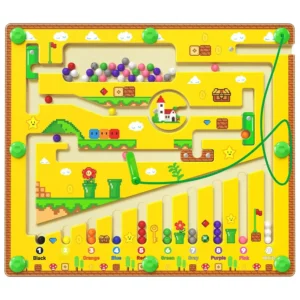
2-in-1 The Ultimate Magnetic Maze & Trouble Board Game | Big Size Board | Super Mario Theme
Original price was: ₹899.00.₹599.00Current price is: ₹599.00. -
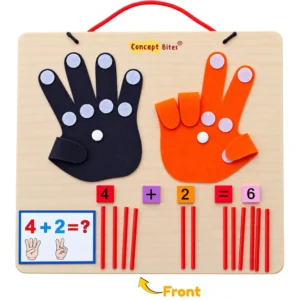
Calendar, Clock and Counting Wooden Activity Board
Original price was: ₹890.00.₹499.00Current price is: ₹499.00. -
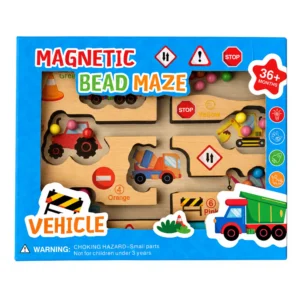
Wooden Magnetic Bead Maze | Blue – Vehicle theme | Montessori Educational Toy with Magnetic Pen | Color & Number Recognition Game for Kids 3+ Years
₹199.00 -
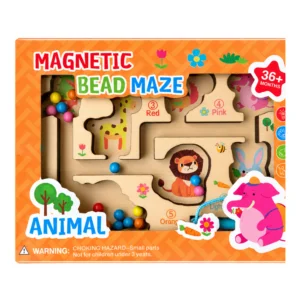
Wooden Magnetic Bead Maze | Orange – Animal theme | Montessori Educational Toy with Magnetic Pen | Color & Number Recognition Game for Kids 3+ Years
₹199.00 -
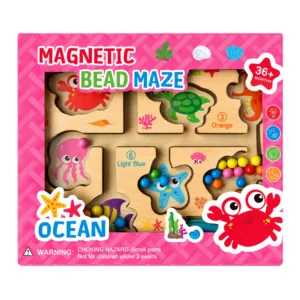
Wooden Magnetic Bead Maze | Pink – Ocean theme | Montessori Educational Toy with Magnetic Pen | Color & Number Recognition Game for Kids 3+ Years
₹199.00 -
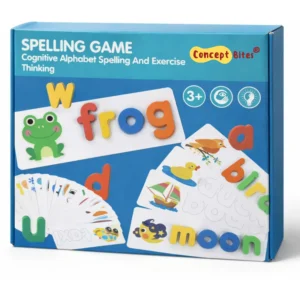
Wooden Spelling Game for Kids 3–7 Years | Montessori Phonics Learning Toy with 28 Flash Cards (56 Words) & 52 ABCD Blocks | Educational Puzzle Gift for Toddlers
₹399.00